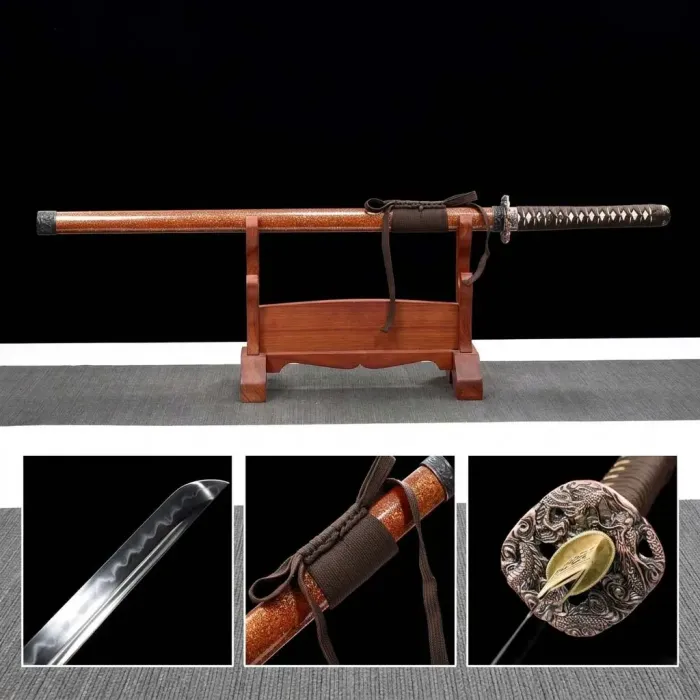
That classic nihonto stands a impressive showcase of talent, but imagine you desire to communicate your separate approach? Adjusting your gear is a insightful journey, allowing you to construct a truly one-of-a-kind piece. From the grasp wrapping and band to the tsuba design and marking, each constituent offers a chance for individual flair. This exploration delves into the territory of katana revisions, providing details for both beginners and proficient enthusiasts hoping to set their endorsement on the historic art of the samurai.
Freshman's Authentic Workmanship
For beginners wanting to embark on the gratifying journey of martial arts involving swords , 1060 steel katanas supply an first-rate entry point. This specific grade of elemental steel balances a fine equilibrium between price and efficiency . While below hard as leading steels, 1060 accommodates a manageable level of honing , making it ideal for starters to enhance the groundwork of blade care and enjoy the charm of original Japanese weaponry. It’s a remarkable choice for fostering experience without the economical burden of more premium steels.
T Gear Steel Cutlasses: Combining Potency and Reasonableness
Satisfying specialists seeking an authentic katana experience without crossing the financial plan, T10 composition katanas represent a advantageous option. These cutlery offer a clear improvement in sturdiness compared to basic alternatives, exhibiting respectable edge retention and enough flexibility for fundamental chopping techniques. While not rivaling the exceptional characteristics of higher-grade steels like T100 or folded compound, T10 provides a admirable blend of effectiveness and economy , making them a widespread choice for newcomers and those on a limited resources .
Surpassing the Steel : Tailoring Your Blade's Fittings and Hold
Though the buffed sword is undeniably the central point of a katana, truly enriching its elegance lies in the cautious customization of its hardware and grasp . This method allows collectors to present their exclusive preference . Assess the ample possibilities: menuki - decorative adornments that introduce visual detail ; the hamon enclosures – often intricately molded ; the tsuka essence itself, wrapped in genuine ito string ; and the fusa knob , which can be crafted from various resources like precious metals or cartilage .
- Opt for ideas that harmonize with you.
- Delve into with assorted mediums.
- Stress quality for a persistent impression .
The Appeal of the Katana: Tradition, Creation, and Alloy
Each nihonto exhibits a unique allure, steeped in generations of Far Eastern history and custom . More than merely a device of hostilities , it's a representation of the knight ethos – a fusion of competence and self-control . Its advancement spanned plentiful generations, with early blades evolving into the refined curvature and sharp edge we understand today. The artistry involved is truly exceptional , requiring spans of preparation to perfect . The process involves a detailed folding of smelted iron , creating layers that augment the sword’s flexibility and incising ability. Several schools of processing developed , each with their individual secrets and styles for achieving the finest harmony and cleanness - a truly heavy pursuit.
- Early Katana shapes
- The function of the samurai blade in fighter culture
- Heritage fabricating systems
Determining the Right Steel for Your Weapon Project: 1060 vs. T10
Identifying the favorable steel is absolutely important for any katana project, and the decision between 1060 and T10 can be tricky. 1060 is a popular American steel, offering a good balance of rigidity and sturdiness, causing it moderately easy to process. However, T10, a Nipponese steel, typically boasts enhanced wear endurance and can potentially achieve a amplified terminal hardness, although it can be relatively laborious to control and requires meticulous heat conditioning. Consider your expertise and intended goals: for a learner, 1060 may be a more straightforward launchpad, while the proficient smith might appreciate the increased traits of T10.
- Facility of Managing
- Surface
- Final Stiffness
Unleashing the Power: High-Level Katana Modification Methods
Becoming proficient in blade modification extends far beyond basic grinding. Serious practitioners are now exploring advanced techniques to truly discover a blade's hidden potential. This requires intricate work with the hamon, utilizing specialized products for differential heat treatment and carefully selecting the configuration of the hand guard to optimize balance and functionality. Beyond purely functional refinements, artisans are increasingly focused on achieving unparalleled aesthetic elegance, through complex engraving and layered glazes that truly transform a katana into a showpiece.
Turning Raw Material into Excellence: Creating a 1060 Katana
The journey embarks with regular 1060 steel , a hard material far from the elegant katana it will develop into. Expert bladesmiths perform a complicated custom katana process of uniting and molding the primary steel, repeatedly warming it and impacting it to remove impurities and develop a symmetrical grain structure. This painstaking process, often spanning for days , builds the required force and pliability characteristic of a bona fide Japanese tool. Additional heat applications , including careful hardening and annealing , are necessary to achieve the aimed balance of sharpness, endurance and loveliness .- Uniting: Removes impurities and develops grain structure.
- Forming: Fabricates the steel into the initial blade form.
- Tempering: Decides the final hardness and flexibility.
The Perpetual Attraction of the Katana: Extensive Study of Steel and Alteration
Such long-standing katana remains a striking symbol within Japanese civilization , its magnetism far outstripping mere military gear. Forged from tamahagane steel and frequently featuring intricate patterns , the technique of creation itself is a hallowed art. Beyond the primary craftsmanship, the ability to adapt a katana - from the edge marking to the shaft wrapping and fitting - provides for a honestly individual demonstration for both curators and participants alike. This confluence of historical steelwork and boundless personalization contributes the katana's continued popularity across the universe.